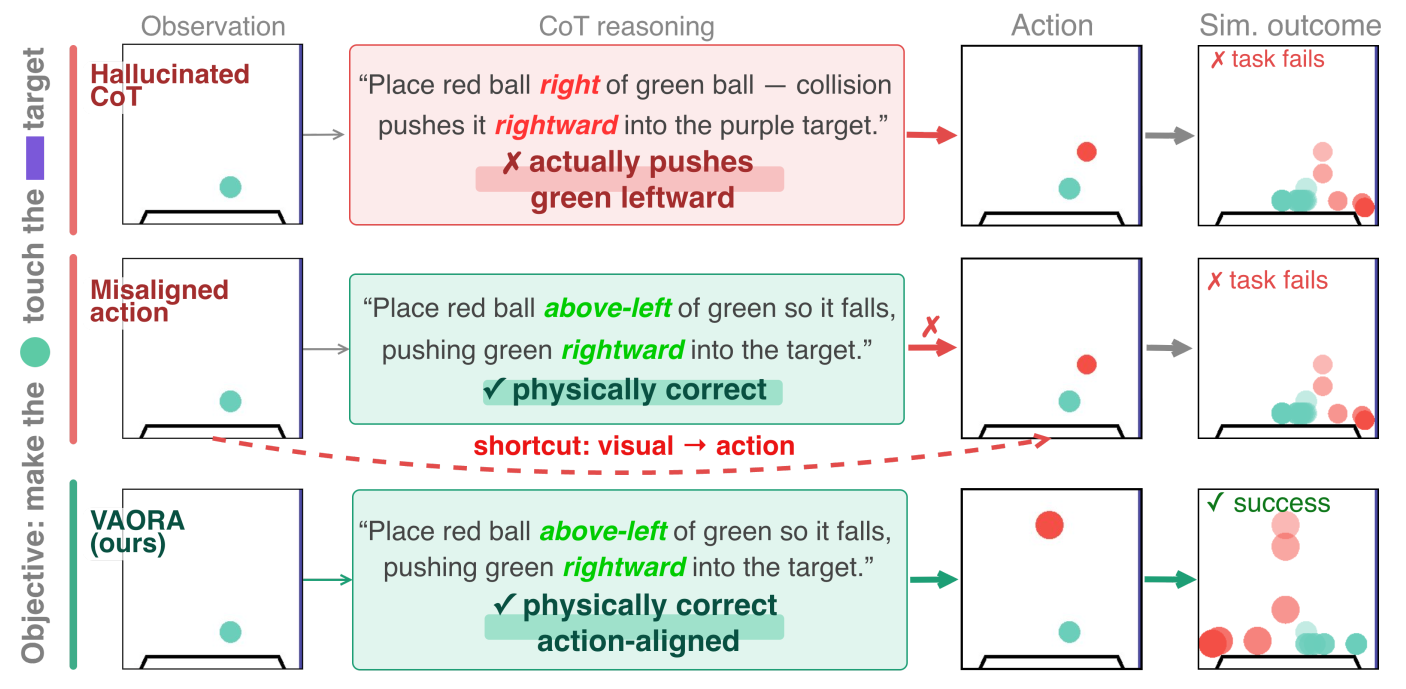
Two major obstacles in CoT-based physical reasoning.Hallucinated CoT denotes the model producing
physically incorrect reasoning that leads to a wrong action; Misaligned Action bypasses physically-aligned
reasoning via a visual shortcut, resulting in wrong action planning. Our VAORA resolves both, generating a
successful action with proper physical reasoning.
Abstract
Vision-language models (VLMs) struggle to generalize in interactive physical reasoning, particularly under unseen
tasks and environments. Two key failure modes are prominent: hallucinated chain-of-thought (CoT) reasoning that
contradicts physical reality, and misalignment between the model's reasoning and actions. We present
VAORA (Visual Action Outcome Reasoning Alignment), a novel reward design that directly addresses both
issues. VAORA introduces two complementary rewards: a Visual Alignment Reward, which anchors VLM reasoning to
the visual context independent of the agent action itself, and a Visual-Action Alignment Reward, which grounds
reasoning in the visual outcome induced by the model's action. Together, these rewards suppress hallucinated CoT and
reduce the gap between reasoning and behavior. To improve training stability, we further employ smooth, dense rewards
by estimating success probabilities using a pre-trained in-domain expert agent. Experiments on PHYRE and Virtual Tool
support our performance across novel-task and unseen-environment settings, confirming that grounded and generalizable
physical intelligence can be induced through VAORA.
VAORA Method
Overview
True physical agents must go beyond memorizing scene configurations and instead reason about spatial relationships,
dynamics, and causality to act in novel situations. We characterize this through two forms of generalization:
cross-task transfer within the same environment, and cross-environment transfer across distinct physics
simulators. Conventional non-VLM agents (e.g., DQN) collapse perception and decision-making into a single opaque
mapping, learning spurious visual-to-action correlations that fail to transfer. Vision-language models offer a
different paradigm by replacing reactive mappings with explicit causal reasoning, yet the two dominant training
paradigms — Supervised Fine-Tuning (SFT) and success-driven RL — each introduce structural limitations.
We identify that both SFT and success-driven RL fail to supervise the connection between CoT reasoning and physical
reality, leading to two failure modes: hallucinated CoT that contradicts physical reality, and
reasoning-action misalignment where the model takes a visual shortcut that bypasses its own stated reasoning.
VAORA resolves both by requiring the reasoning trace to remain consistent with the visual observations of the
environment — both the initial scene and the post-interaction outcome — within a shared symbolic space.
Framework
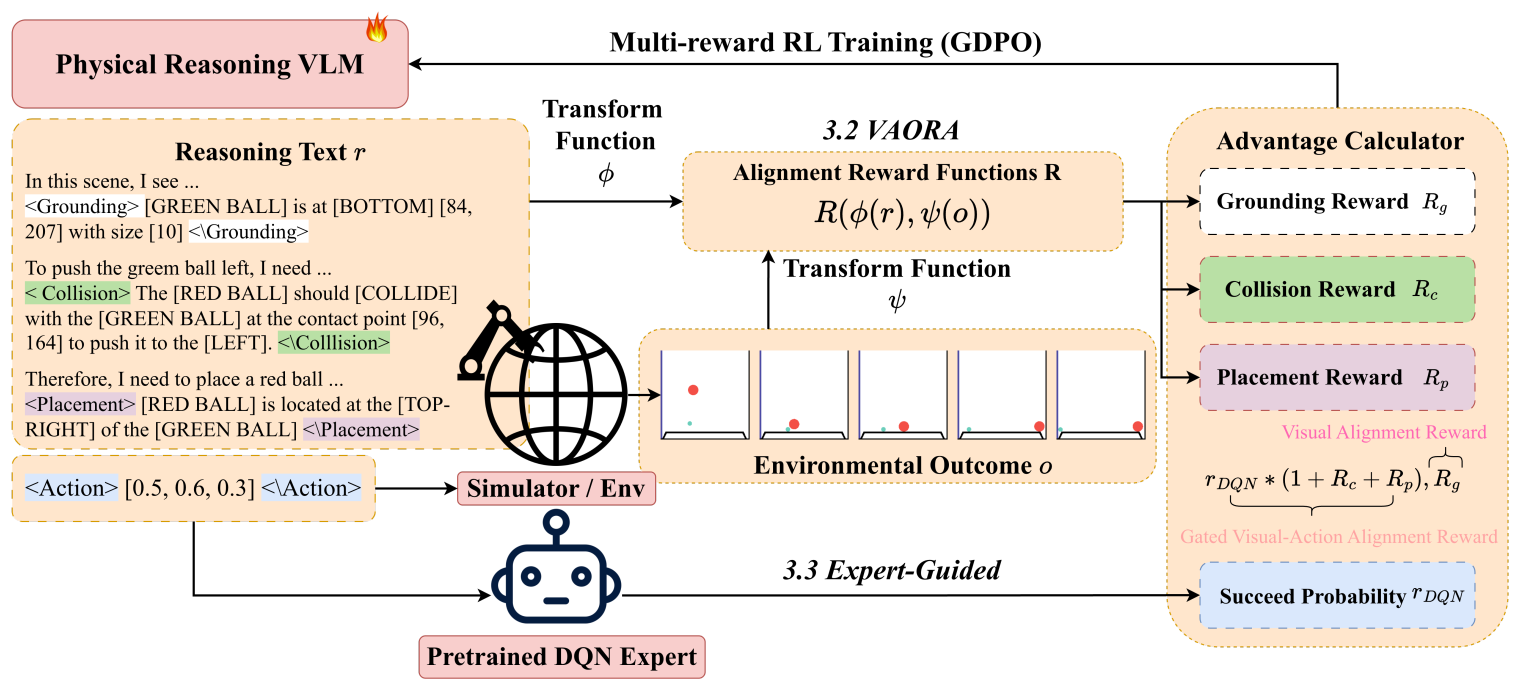
Framework. VAORA consists of two components: (a) Visual-Alignment Reward, which anchors reasoning to
action-independent visual context (the grounding reward rG). (b) Gated Visual-Action Alignment
Reward, which aligns reasoning with the visual outcome of the model's action (the collision reward
rC and placement reward rP), gated by a success probability estimated by a pre-trained
DQN expert. The reasoning chain, initial scene observation, and post-interaction outcome are projected into a shared
symbolic space where their consistency is measured.
Reward Design
Visual Alignment Reward. To anchor the reasoning trace to a scene independent of the model's action, the
grounding reward rG aligns the VLM's perception of the initial scene configuration with the real
initial observation. A model that cannot accurately perceive the scene before acting will inevitably produce reasoning
inconsistent with physical reality, so this reward directly attacks hallucinated CoT at its source.
Visual-Action Alignment Reward. Two rewards ground the reasoning trace in the physical consequences of the
action. The collision reward rC aligns the model's predicted collision events with the
post-interaction outcome, while the placement reward rP aligns the predicted ball placement with its
actual position in the first post-interaction frame — together addressing reasoning-action misalignment.
Expert-Guided (EG) Optimization. Sparse binary task-success rewards in continuous action spaces often cause
policy collapse. We replace the binary success signal with a smooth, dense success probability estimated by a
pre-trained DQN expert, rDQN. The visual-action alignment rewards are gated by rDQN so that
reasoning quality is rewarded only when the action is physically plausible, while rG is optimized outside
the gate. The two components are jointly optimized with GDPO.
Experiment Results
Generalization Settings
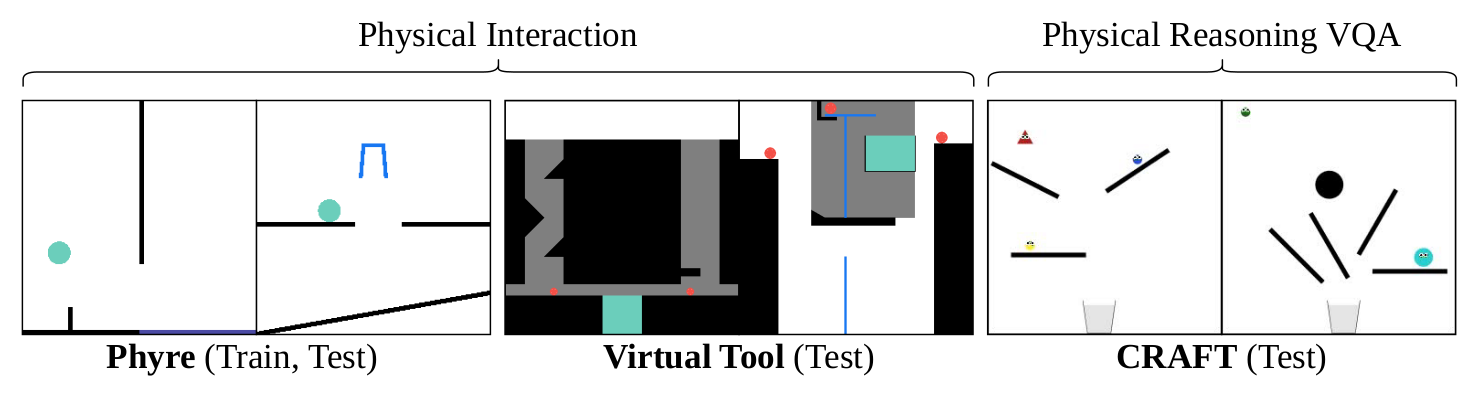
Generalization of VAORA. We train VAORA on PHYRE tasks and evaluate across three scenarios: (a) the PHYRE
test set for cross-task generalization, (b) Virtual Tool for cross-engine (cross-environment) generalization,
and (c) CRAFT VQA to assess the transferability of learned reasoning to visual question answering.
Results
VAORA substantially outperforms open-source VLMs and the majority of closed-source API baselines, and surpasses the
in-domain DQN expert on most metrics — demonstrating that properly aligned reasoning confers a genuine generalization
advantage over direct visual-to-action mapping agents. The full model (+EG+VAORA) is highlighted.
Pass@k on PHYRE test sets across three held-out task splits. VAORA outperforms all VLM baselines and surpasses the in-domain DQN expert on most metrics (bold = our full model).
Models
Testing Set 1
Testing Set 2
Testing Set 3
Pass@1
Pass@3
Pass@5
Pass@1
Pass@3
Pass@5
Pass@1
Pass@3
Pass@5
Human
0.520
0.758
0.800
0.472
0.822
0.920
0.520
0.732
0.820
DQN-expert
0.326
0.434
0.476
0.260
0.368
0.418
0.338
0.412
0.466
InternVL-3.5-8B
0.044
0.094
0.134
0.028
0.084
0.130
0.050
0.104
0.154
Qwen3VL-8B
0.002
0.008
0.200
0.018
0.044
0.078
0.016
0.040
0.074
Qwen3VL-8B (SFT)
0.176
0.380
0.470
0.146
0.344
0.452
0.176
0.368
0.452
Qwen3VL-8B (GRPO)
0.006
0.040
0.062
0.016
0.038
0.056
0.024
0.060
0.108
Qwen3VL-8B (SFT+GRPO)
0.020
0.026
0.030
0.042
0.124
0.172
0.022
0.078
0.102
Claude-Sonnet-4.6
0.042
0.104
0.142
0.036
0.088
0.122
0.030
0.074
0.108
GPT-5.4
0.064
0.132
0.186
0.048
0.096
0.144
0.044
0.086
0.140
Gemini-3.1-Pro
0.278
0.472
0.552
0.220
0.368
0.420
0.278
0.484
0.554
Gemini-3.1-Flash
0.170
0.340
0.416
0.192
0.302
0.352
0.142
0.294
0.376
Ours: +EG (Expert-Guided)
0.270
0.436
0.512
0.178
0.312
0.362
0.218
0.340
0.392
Ours: +EG+VAORA
0.382
0.524
0.594
0.198
0.390
0.472
0.300
0.456
0.512
Pass@k on Virtual Tool, evaluating cross-engine generalization of models trained solely on PHYRE. VAORA achieves the best Pass@1 and stays competitive with frontier closed-source VLMs, despite never seeing Virtual Tool during training.
Models
Pass@1
Pass@3
Pass@5
Human
0.333
0.661
0.778
DQN-expert (PHYRE)
0.000
0.056
0.056
Qwen3-VL-8B-Instruct
0.056
0.167
0.167
Qwen3-VL-8B (SFT)
0.000
0.167
0.222
Gemini-3.1-Flash
0.111
0.278
0.278
Gemini-3.1-Pro
0.111
0.278
0.389
Ours: +EG+VAORA
0.167
0.222
0.333
CRAFT VQA accuracy (%) across five physical-reasoning categories. Training exclusively on PHYRE, VAORA improves over the base model, SFT, and EG across all categories — the learned reasoning transfers beyond the interactive training environment.
Method
Descriptive
Counterfactual
Enable
Causal
Prevent
Overall
Qwen3-VL-8B-Instruct
26.60
41.70
40.70
42.00
40.70
38.34
SFT
37.70
46.90
43.90
44.70
47.50
44.14
+EG
38.50
44.50
46.00
42.30
51.50
44.56
+EG+VAORA
39.40
48.20
46.30
45.90
50.50
46.06
Reward breakdown across cross-validation sets. SFT improves only non-interactive grounding, EG risks reward collapse, while VAORA consistently achieves the highest grounding, placement, and collision rewards across all testing sets.
Method
Testing Set 1
Testing Set 2
Testing Set 3
Ground
Place
Collide
Ground
Place
Collide
Ground
Place
Collide
Qwen3-VL-8B-Instruct
0.017
0.022
0.000
0.013
0.029
0.000
0.015
0.023
0.000
SFT
0.710
0.348
0.255
0.670
0.496
0.299
0.695
0.297
0.419
+EG
0.424
0.000
0.401
0.639
0.512
0.297
0.739
0.523
0.373
+EG+VAORA
0.753
0.586
0.511
0.699
0.641
0.407
0.739
0.640
0.525
Ablation of alignment components on Testing Set 3 (Pass@k). Each reward — grounding (rG), placement (rP), and collision (rC) — provides complementary gains; supervising a broader set of outcomes yields higher generalization.
Method
Pass@1
Pass@3
Pass@5
SFT
0.176
0.368
0.452
+EG
0.218
0.340
0.392
+EG+VAORA (rG)
0.272
0.432
0.488
+EG+VAORA (rG, rP)
0.286
0.420
0.486
+EG+VAORA (rG, rC)
0.282
0.426
0.476
+EG+VAORA (rG, rP, rC)
0.366
0.474
0.514
BibTeX
@inproceedings{anonymous2026vaora,
        title={Bridging Physical Reasoning and Task Generalization via Visual Action Outcome Reasoning Alignment},
        author={Anonymous Author(s)},
        booktitle={Advances in Neural Information Processing Systems (NeurIPS)},
        note={Under double-blind review},
        year={2026}
      }